
 Posts
Posts


Friday, 24 February 2012
Trail running: tips for running uphill
Like the previous posting: Some advice from Scott Jurek. This time on running uphill.

Trail Running: Avoid some common mistakes
Heading out on a trail for the first time? Ultra runner Scott Jurek will give you some advice how to avoid some of the common mistakes made by runners who leave the road for the first time:
Thursday, 23 February 2012
Knitting your shoe? The next step towards barefoot running
In the dutch Runnersworld of last week the big shoe test. It is overtaken by the new release of the Nike Flyknit. The trend visible in the test is less and less shoe to approach barefoot running. The Nike Flyknit is the next step in this evolution.
The startpoint for this new shoe? The comfort a sock offers: “A sock fits great, feels snug, goes unnoticed, and you get no irritation,” Yeah sure but how about stones, glass on the pavement or some support during running. No such thing in a sock. Than the Nike Flyknit is the solution.

What I like about this shoes is that it is designed to meet the wish of the (common) runner. That the (industrial) engineer face a s#!t load of problems to realise this wish is basically a designers dream. Solving al the problems. That is took the engineers 4 years is no punishment if you like such a challenge. The shoe is not entirely new. The Lunar(lon) sole is in use in the shoeline with the same name and the flywire is used as well in commercially available shoes.
Besides the topline shoes weighing 160 gramms Nike will release a trainer of only 270 gram. The top model is for the runners of the olympic marathon next summer in London. On the site co.design is an extensive article. Off course you can find the pressrelease also on the Nike site. Below a couple of videos: and number 2:
The startpoint for this new shoe? The comfort a sock offers: “A sock fits great, feels snug, goes unnoticed, and you get no irritation,” Yeah sure but how about stones, glass on the pavement or some support during running. No such thing in a sock. Than the Nike Flyknit is the solution.
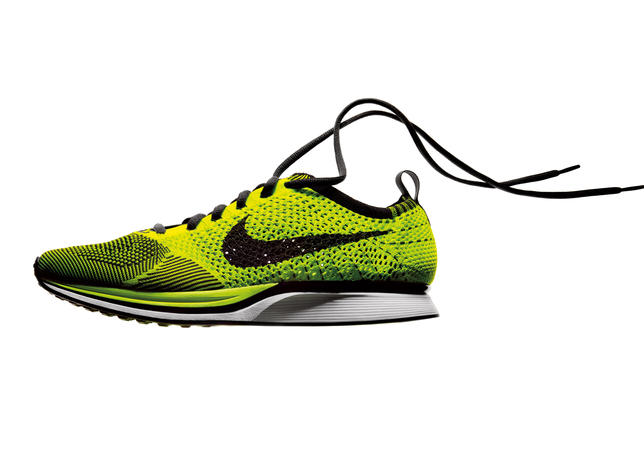
What I like about this shoes is that it is designed to meet the wish of the (common) runner. That the (industrial) engineer face a s#!t load of problems to realise this wish is basically a designers dream. Solving al the problems. That is took the engineers 4 years is no punishment if you like such a challenge. The shoe is not entirely new. The Lunar(lon) sole is in use in the shoeline with the same name and the flywire is used as well in commercially available shoes.
Besides the topline shoes weighing 160 gramms Nike will release a trainer of only 270 gram. The top model is for the runners of the olympic marathon next summer in London. On the site co.design is an extensive article. Off course you can find the pressrelease also on the Nike site. Below a couple of videos: and number 2:
Endurance runner in car commercial
Running in commercials. Usually only when it is to promote running gear. But this is about to change with this commercial by Opel, introducing his electric Ampera with range-extender.
This, according to Opel, remarkable achievement is compared with three athletes:
More fun than the commercial is 'the making of..' with the title 'Going Further':
This, according to Opel, remarkable achievement is compared with three athletes:
- Scott Jurek: ultra runner, 266km in 24 hour
- William Trubrigde: free diver, 101 meter depth
- Steve House: climber, solo K7, over 6000 meter
More fun than the commercial is 'the making of..' with the title 'Going Further':
Friday, 6 May 2011
Organized by one of the UN organizations and as part of the summergames for children: a marathon in Gaza strip.
The children ran it as a relay and 9 adults completed the entire marathon. Winner of this first ever marathon in Gaza strip is Nader al-Misri in 2:42:47. He is in training for the olympic marathon of London 2012.
Check out the numbers on the runners shirts. Looks like everyone brought his own number along.
Background on this UN initiative on the UN website.
Sorry but the video is partly in Dutch but it gives a nice impression of the event.
The children ran it as a relay and 9 adults completed the entire marathon. Winner of this first ever marathon in Gaza strip is Nader al-Misri in 2:42:47. He is in training for the olympic marathon of London 2012.
Check out the numbers on the runners shirts. Looks like everyone brought his own number along.
Background on this UN initiative on the UN website.
Sorry but the video is partly in Dutch but it gives a nice impression of the event.
Monday, 28 February 2011
Pose Method: let gravity help you!
Wanna run with an heart rate of 10 bmp below your normal HR? According to this video it is possible with the use of the so called 'pose method'.
Basically it nothing more than keeping your body tilted forward as shown by the picture below. On the left Dr. Nicholas Romanov who came up with this method tiltiign forward, on the right a 'regular' runner with an upright upper body.

With this pose you also alter your step where you don't push yourself forward but simply 'lift' your leg at the end of the stride. And as the still might suggest you probably will use fore foot landing as well as you don't extract your leg that far foreward.
This tip might be useful for a lot of recreational runners as they tend to run with a rather upright upper body. Pay attention next time you go running by looking at other runners but also at yourself. Fore example if your run in an builded area; look in a large shop window for your own reflection.
The picture above is a still from the BBC video below on the pose method.
Dr. Romanov is not just any runner. As a scientist he was part of the 2000 and 2004 British team for the triathlon on the Olympic games.
The guinea pig is this video is tested running at the same speed running regular en running using the pose method. usig the pose method he runs at a 10bpm lower HR.
Basically it nothing more than keeping your body tilted forward as shown by the picture below. On the left Dr. Nicholas Romanov who came up with this method tiltiign forward, on the right a 'regular' runner with an upright upper body.

With this pose you also alter your step where you don't push yourself forward but simply 'lift' your leg at the end of the stride. And as the still might suggest you probably will use fore foot landing as well as you don't extract your leg that far foreward.
This tip might be useful for a lot of recreational runners as they tend to run with a rather upright upper body. Pay attention next time you go running by looking at other runners but also at yourself. Fore example if your run in an builded area; look in a large shop window for your own reflection.
The picture above is a still from the BBC video below on the pose method.
Dr. Romanov is not just any runner. As a scientist he was part of the 2000 and 2004 British team for the triathlon on the Olympic games.
The guinea pig is this video is tested running at the same speed running regular en running using the pose method. usig the pose method he runs at a 10bpm lower HR.
Sunday, 27 February 2011
Stretching:Yes or No? Don't change your habit!
I've written before on the topic of stretching. Should you do it yes or no and does it help?
Recent research has shown that, with recreational runners there is no difference in the risk your run (nice phrase in this context) on injuries related to your exercises.
With or without strechting one in six runners, in this research experienced an injuries. The risk of an injury was more related to high BMI (overweight) or prior injuries.
The 'test subjects' that changed their habbit and started stretching or stopped strechting ran a risk higher risk. On average roughly one in four experienced injuries.
The researches can not explane this results but to me, of course the disclaimer is in place - I'm not an expert -, is that it has to do with the changed muscle tone after stretching. It will have an effect, even minute, on your running style and every change in style makes you more prone to injuries untill the change has settled in and became the new standard.
So if you want to change; don't or (to my humble opinion) do it gradually....

more details on MedicineNet
Recent research has shown that, with recreational runners there is no difference in the risk your run (nice phrase in this context) on injuries related to your exercises.
With or without strechting one in six runners, in this research experienced an injuries. The risk of an injury was more related to high BMI (overweight) or prior injuries.
The 'test subjects' that changed their habbit and started stretching or stopped strechting ran a risk higher risk. On average roughly one in four experienced injuries.
The researches can not explane this results but to me, of course the disclaimer is in place - I'm not an expert -, is that it has to do with the changed muscle tone after stretching. It will have an effect, even minute, on your running style and every change in style makes you more prone to injuries untill the change has settled in and became the new standard.
So if you want to change; don't or (to my humble opinion) do it gradually....

more details on MedicineNet
Subscribe to:
Posts (Atom)
