Next Run: Brussels 42K

2012-10-07 09:00:00 GMT+01:00

Rainradar

Click on the image or here for large image!
Showing posts with label stretching. Show all posts

Thursday, 16 August 2012

Stretching: Inner Tigh or Adductor

After discussing the stretching of the calf muscle, the lower calf muscle, hamstring, buttocks, the quadriceps and the IT band (outside upper leg) the only thing left is the inner thigh. As you can tell from the streetplan to your muscles this is the Adductor or Adductor Longus.

The video below shows how you can stretch this muscle in a sitting mode but during the warming up or cooling down of a run outside a standing mode might be more convenient.

So here is the 'how to' of stretching your inner thigh in  standing mode:
  • Place your feet wide apart with the toes pointing forward;
  • Slowly bring your body and weigth over f.e. your left foot while bending your left knee;
  • you will notice you automatically lower your centre of gravity roughly located around your hips;
  • You can feel the tension build on the inner side of your right upper leg;
  • After stretching the adductor of your right leg come back to the beginning position and mirror the movement for your left adductor.
Have fun!

Wednesday, 15 August 2012

Stretching: the IT band

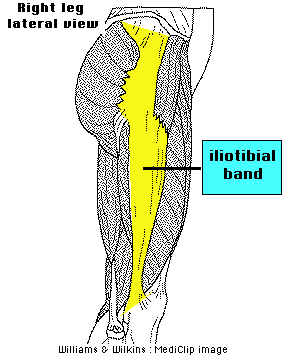
This time, in the category 'stretching' the IT band, or iliotibiale band. The IT band is situated on the outside of your upper leg and is prone to a injury around the knee. With some stretching you can deal with this injury of maybe even prevent it.

The IT band friction syndrome:

The IT band on the outside of your upper leg is attached to your hips, lets say underneath your belt while wearing jeans and runs all the way down to just below your knee where it is attached to your tibia, the shinbone in your lower leg.
Asymmetric loading that pushes the knee outwards will cause friction between the IT band an the outside of the knee joint. This is called the IT band friction syndrome. From my own experience I can tell you it can cause a somewhat nagging  pain while stretching the knee. During running this pain can become more serious and leading to a jolt of pain with every step you take.

So lesson 1: avoid asymmetric loading. So do not run on the same shoulder of the road all the time and when on a beach; turn back in time.

Stretching the IT band

Stretching this IT band can be done in multiple ways.

Method 1: It is a bit like skating on a 400m ice rink and full into the curve....

Method 2: A useful addition to method 1. To my opinion the first method tackles mainly the upper end of the IT band on your hips. This method as shown in the video is more prone to stretch near your knee!


Method 3: Is the same as stretching the gluteus maximus (or buttocks) to be found in this posting.

Tuesday, 14 August 2012

Stretching: Hamstring

Next on the menu for stretching exercises is the hamstring. You can stretch the hamstring at the back of your upper leg in various ways. There are two methods you can do sitting but it can be done standing as well. Standing is easier when outside during a run either warming up, or cooling down.

First one of the methods you can perform standing:


Sitting (one leg):


This exercise can also be done in a standing mode. Here is how:

  • Find a fence or wall of roughly the same height as your hips (a bit lower is OK, higher? Better not);
  • Place on foot on the fence, best your heel so you can point your toes towards you;
  • Bend the leg you stand upon until the leg on the fence is horizontal;
  • grab your foot as in the video.


Sitting (both legs): 


This one can be done in a standing mode as well and no, not by placing both legs on the fence.

Place your feet next to each other en simple bow and touch your toes or ankles as low as you can. If you come op do it slowly stretching your spine vertebrae by vertebrae.

It is also possible (and smart) to pay attention to your posture when you bend to touch your toes. Both in the sitting method as in the standing method. Not just reach for your toes and grab them as in the video.
  • Start with stretching your arm up try to reach for the ceiling/sky/heavens above depending your location and conviction;
  • make yourself as long as possible while keeping you feet flat on the ground;
  • Bend in your hips while your arms stay in line with your back all the way to the horizontal position of your upper body;
  • Then,  vertebrae by vertebrae, bend your spine and if agile enough your hands will touch your toes or ankles in due time;
  • Only if need be you can bend your arms at the shoulder to complete the movement and touch your toes.
By performing the stretch in this way your probably not only stretch your hamstrings but also your calf muscles. Wanna give them some special attention? Read my blog on stretching the calf muscles and the lower calf muscle.

Stretching: A streetplan to your Muscles

A couple of times I addressed the topic of 'Stretching' on this blog. I already addressed the calf muscle and the muscles in your but. More on this topic can be found by using the label stretching.

If you wanna know more on the various muscles in your body you can find the to images displayed below on the website of the BBC. Consider it a streetplan to the muscles in you body. If you follow the link to the BBC website you find these maps 'clackable and learn more on each an every group of muscles.

First the image with the muscles on the front of the body:
source BBC science


and secondly the back of the body:
source BBC science

While you at it. Enjoy also this interactive page with more information on the human body.

Sunday, 27 February 2011

Stretching:Yes or No? Don't change your habit!

I've written before on the topic of stretching. Should you do it yes or no and does it help?

Recent research has shown that, with recreational runners there is no difference in the risk your run (nice phrase in this context) on injuries related to your exercises.
With or without strechting one in six runners, in this research experienced an injuries. The risk of an injury was more related to high BMI (overweight) or prior injuries.

The 'test subjects' that changed their habbit and started stretching or stopped strechting ran a risk higher risk. On average roughly one in four experienced injuries.
The researches can not explane this results but to me, of course the disclaimer is in place - I'm not an expert -, is that it has to do with the changed muscle tone after stretching. It will have an effect, even minute, on your running style and every change in style makes you more prone to injuries untill the change has settled in and became the new standard.
So if you want to change; don't or (to my humble opinion) do it gradually....


more details on MedicineNet

Saturday, 31 January 2009

Stretching yes or no? A poll

The University of Nevada has done some research on the effect of stretching before running. Google for articles or follow this link for one of them. In general the message is that static stretching has no use or even might weaken your muscles before an excersies. I myself, although I write about it on this blog, I usually stretch only after running and mostly just my lower calf muscles. I have published a poll on the right of this blog. As Dutch is the default language the button 'stemmen' means 'vote' and 'resultaten weergeven' means 'show results'. I will also post this poll on Running in Business at LinkedIn for more results.

Wednesday, 31 December 2008

Stretching: Gluteus Maximus a.k.a. butt

It has been somewhile ago that I addressed stretching in this blog. So today, to make it up, stretching the Gluteus Maximus or otherwise know as your butt!
rekken bilspier
One method is to lay on your back and pull your knee into your chest (see post stamp on the right). For me this method does not deliver the result I was looking for.
I prefer a bit more complicated method which works for me. The first couple of times I did this kind of stretching in noticed the next day that it worked every time I wanted to get up from my chair or was walking up the stairs. My buttocks were painful.

Here how you strethc your right butt, I expect you to figure out how you can do your left one....
  • Sit down on the floor with both legs straight in front of you and a straigth back
  • Place your right foot on the left (outside) of your left knee and grab with your left hand just below your left knee. With this take care of passing your right leg, with your left arm on the right hand side (still with me?). Your elbow of your left arm will push your right knee to the left
  • turn your upper body to the right place, if need be, your right hand behind you
  • push your right knee to the left with your left arm you will feel the tension build in your gluteus maximus a.k.a. butt
Maybe it is a puzzle the first time around but for me it works.


This picture comes close but lets say this is the easy way to do it. To make it more effective he should push his right knee to the left with his left elbow so he can place his left hand on the outside of his left knee. This will put more tension on your buttocks and also the outside of your leg. (see IT band).


Tuesday, 18 December 2007

Stretching: lower calf muscle

Many of the less experienced runnners do just one sort of stretching for the calf muscle. The regular stretch. They tend to forget the lower calf muscle which is connected to the achillesheel and not paying the proper attention can cause injuries to the heel. Stretching the lower calf muscle is quite simple
1) place your feet alngo side eachother and make one step with your hips (your centre of gravity) between your feet as with the regular calf muscle stretch.
2) Keep your upper body vertical but lower your centre of gravity (i.e. your hips) by bending both kness. You feel the strain building in the lower extremities of your calf of your 'hind'leg.

Pay attention to:
- Keeping your heel on the ground
- DOn't bring your knees in front of the toe of your foot. If you do before you feel the straing increase your step a little at 1.)

Sunday, 16 December 2007

Stretching: The Quadriceps

A few times before I have written about stretching.

Recently I read an article in 'Gym Kaderinfo' a magazine about gymnastics (which used to do for some 15 years when I was a bit younger). In the article, the doctor John Mens discusses the use of stretching and basically he states that it is useless. However with the article is a picture of this good man stretching his Quadriceps. I have no scanner at hand so you´ll have to do with my figures. It looked a bit like this:


Added 2/1/08 scanned image from article:

I could be wrong but to me this is not the right way to stretch your quadriceps. Body to the front, the leg he is standing on overstretched. With this kind of examples I can understand that to him stretching is nog usefoull;-)
This is how I learned your quadriceps should be stretched:

  1. raise your heel to your buttocks
  2. genlty bend the leg your standing on

  3. tilt your pelvis a bit (in the direction of the arrow, belly in)

  4. bring the knee of your raise leg slowly to the back building the tention in the muscle

Your pose will look like this figure:


Or use the clip from the asics site as inspiration.


Saturday, 27 October 2007

Stretching: how to be done?

Last week during the marathon I looked in surprise at a man leaning into a lamp post almost horizontaly stretching his calfmuscle. Hand at about a meter height and heel from the ground. This urges me to write once more about stretching. This time stretching in general.
Is stretching usefull?
exploring the web you'll find that there is some debate on the usefulness of stretching. Almost every runners does it in the belief that it helps to lengthen the muscles en increases its resistance to injuries. It also decreases muscle pain after excersises when stretching is applied during the cooling down.
The purpose of stretching
By stretching the muscle you lengthen it and put tension on the fibers. After the stretching the muscle relaxes and is in a more relaxed mode than before.
During the cooling down stretching keeps the bloodflow going, helping to get rid off the waste products in the muscle (hence the reduction of musclepain afterwards). I also thinks that the relaxation of the muscle has a good healthy effect on the tendon reducing the risk of injuries but i could not find proof of tihs quickly.
Static versus dynamic
there are different ways of stretching:

Best knwon are static and dynamic. The second was out of fashion after the appearance of the book 'The Stretching Methode' by Bob Anderson.

Sequence of stretching
I never gave much thought to the sequeance in which I did my stretching untill recently someone pointed out that stretching the muscles in the upper leg first stimulates the blood flow so that when stretching the muscles in the lower leg the waste products from these muscles are better transported. Makes sence, doesn´t it?

When to stretch?
Most runners do a warming up first and then stretch before starting with some serious excercises. Taking into account the point made above you realize you should not stretch to fanatical before starting you excersises otherwise your muscles will be completely relaxed.

Other good moments for stretching are, under the assumption that it is healthy, after your excercise, during your cooling down or when you have muscle cramps.

Now let us return to the runner and his lamppost. Taking everything into account you realize stretching has no use when you put strain/force on the muscle because it won't relaxe. I don't know about you but I cannot lean into a lamppost and lift my heal from the floor without straining my calf muscle. So his pose was not effective and he still had to do another 15k.


In spite of all the fact that the debate about the use of stretching has not settled I myself find it useful. I think that on 50% of the runs I do, I do stretch it after some warming up and on 90% of the runs I stretch afterwards. (I skip when I am in a hurry).
Before I was not albe to reach my toes as the lady does in the picture...now I can. So to me it helps. And in the book on running from Haile G. he spends a few pages on stretching and it helped him to run the worldrecord so who am I to argue with him.

Friday, 22 June 2007

Stretching; Calf Muscle

Do you recognize this: People in sporting gear trying to push over a wall or lamppost? I don't think that is the proper way to stretch your calf muscle. Because you should be stretching it and not put strain on it which you'll do the minute you start pushing. So how should it be done?

1) place you feet next to eachother and make a step of normal length with your center of gravity (your hips) between your feet.
2) Bend the knee of your front leg and have your upper body and back leg in a straigth line. Keep the heel of your back foot on the ground. DOn't push an against a wall;-)
If you need support try to grab something on your side so you use it just for that: balance.

Hold this position for at least eight seconds. Than come back to the starting position and repeat the motion with the other leg. In video it looks like this (thanks to the Asics site):
id='kuiten_bstr'
codebase='http://activex.microsoft.com/activex/controls/mplayer/en/nsmp2inf.cab#Version=7,0,0,1954'
standby='Loading...' width='240' height='180' >


name='kuiten_bstr'
title="Zijaanzicht - Kuiten (gestrekt)"
pluginspage='http://www.microsoft.com/Windows/MediaPlayer/'
type='application/x-wmplayer'
loop='true'
cache='true'
controller='false'
showcontrols='false'
autostart='true'
autoplay='true'>