Next Run: Brussels 42K

2012-10-07 09:00:00 GMT+01:00

Rainradar

Click on the image or here for large image!

Tuesday, 14 August 2012

Stretching: Hamstring

Next on the menu for stretching exercises is the hamstring. You can stretch the hamstring at the back of your upper leg in various ways. There are two methods you can do sitting but it can be done standing as well. Standing is easier when outside during a run either warming up, or cooling down.

First one of the methods you can perform standing:


Sitting (one leg):


This exercise can also be done in a standing mode. Here is how:

  • Find a fence or wall of roughly the same height as your hips (a bit lower is OK, higher? Better not);
  • Place on foot on the fence, best your heel so you can point your toes towards you;
  • Bend the leg you stand upon until the leg on the fence is horizontal;
  • grab your foot as in the video.


Sitting (both legs): 


This one can be done in a standing mode as well and no, not by placing both legs on the fence.

Place your feet next to each other en simple bow and touch your toes or ankles as low as you can. If you come op do it slowly stretching your spine vertebrae by vertebrae.

It is also possible (and smart) to pay attention to your posture when you bend to touch your toes. Both in the sitting method as in the standing method. Not just reach for your toes and grab them as in the video.
  • Start with stretching your arm up try to reach for the ceiling/sky/heavens above depending your location and conviction;
  • make yourself as long as possible while keeping you feet flat on the ground;
  • Bend in your hips while your arms stay in line with your back all the way to the horizontal position of your upper body;
  • Then,  vertebrae by vertebrae, bend your spine and if agile enough your hands will touch your toes or ankles in due time;
  • Only if need be you can bend your arms at the shoulder to complete the movement and touch your toes.
By performing the stretch in this way your probably not only stretch your hamstrings but also your calf muscles. Wanna give them some special attention? Read my blog on stretching the calf muscles and the lower calf muscle.

Stretching: A streetplan to your Muscles

A couple of times I addressed the topic of 'Stretching' on this blog. I already addressed the calf muscle and the muscles in your but. More on this topic can be found by using the label stretching.

If you wanna know more on the various muscles in your body you can find the to images displayed below on the website of the BBC. Consider it a streetplan to the muscles in you body. If you follow the link to the BBC website you find these maps 'clackable and learn more on each an every group of muscles.

First the image with the muscles on the front of the body:
source BBC science


and secondly the back of the body:
source BBC science

While you at it. Enjoy also this interactive page with more information on the human body.

Friday, 3 August 2012

The future of exercising and healthy living?

A friend draw my attention to this very nice short movie. It is both a view into the future of exercising, healthy living (relevant for this blog;p) and dating but also has a nice story line with a great cliff hanger. Just sit back and enjoy (probably just on your tablet, smartphone or ordinary old fashioned laptop...

Thursday, 2 August 2012

RunningDutch Review: Amsterdam Marathon

This autumn will see the 37th edition of the Amsterdam Marathon.

The Location
Amsterdam is the capital of the Netherlands and abroad probably the most well known Dutch city. Probably for its canals, coffeshops  and red light district but also the 'Rijksmuseum' with paintings from Rembrandt and the Anne Frank House.
Important for you as reader of this blog: It is also the venue of a very popular marathon.

If you consider visiting Amsterdam to take part in the marathon you can consider to take a canal tour or a coffeeshop tour. The latter maybe after the race?

Hotels? No problem in Amsterdam as you can tell from booking.com or Expedia.

The course: Fast, scenic, historic and a brilliant finish 
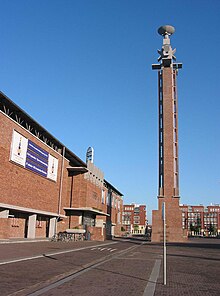
Tower in front of stadium
The course is flat and therefore fast. The wind however can be tricky but later more on that topic.
The start of the marathon is in the Olympic Stadium. Originally built for the Olympic Games of 1928 but beautifully renovated in 2000 with a very good 400m track.

After 200m on this track you leave the stadium passing the tower which held the Olympic fire and, with eye for detail, measures 42 meters and 19,5 centimers. Recognise the numbers?

Find your pace on the wide road leading away from the stadium towards the 'Vondelpark' on a average Sunday crowded with people enjoying the sun, jogging around etc. Remember the scenic part of the course as you will run it again in opposite direction on your way back. You run past the Rijksmuseum and loop back to the stadium.

 The cours:
> Flat
> Fast
> Historic
> Start & Finish in Olympic Stadium
Only 7k en route you leave the stadium behind you for a second time and head for the river Amstel to run on the historic route of the Olympic marathon of 1928. You join the rive around km 12 heading south east. Around km 15 you make a small loop leaving the river clearly added to make up the distance of the 42k.

You run on along the scenic Amstel joined by boats with music and people cheering you on. You cross the river at 19 and run back on the opposite site. At my pace (5min.km) I have the opportunity to see the elite running this homeward stretch while I myself still have the outbound leg ahead of me.

It is along this river that the wind can be tricky as the route is in the open.

As for most people the true marathon starts around the 25k. It is no fun to be running for some 5k in a more industrial area with little people along the route before you come into residential area's again.

I myself find the 37k mark the difficult spot. First you head into a short tunnel in order to cross underneath a major road. Climbing out of the tunnel you continue the climb to cross the Amstel once more. Only little elevation it is enough for me. If you experience no problems enjoy the view to your right while crossing the Amstel.

After running trough the Vondelpark the second and last time you head for the stadium to finish on the very comfortable running track. Feel like the elite runners cheered on from the stands by the people in the stadium.
clikc course map for lager image


The organisation: Professional
The event is very well organised, the infrastructure around the start en finish area is ok. The drop off point for  your bag with clothes can be crowded and the dressing area is in a sport hall a couple of 100 meters from the start and finish. Nice for warming up and cooling down. On a colder October day this can mean you can get a little bit cold before you can change you wet running apparel. You'll get a thermo blanket after the finish line to stay warm.
The route (see above for more details) is free of cars and spectators, refreshing posts are with water and sports drinks at every 5k. No complaints on this front.

The entourage: OK
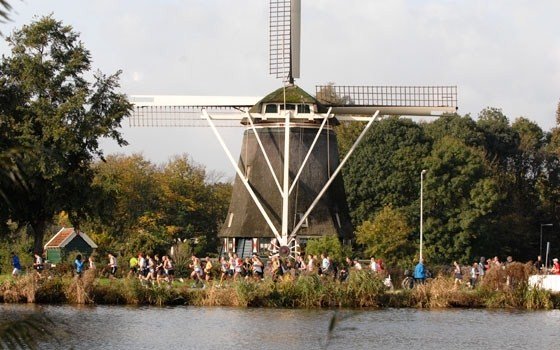
Coming from abroad the route can be found scenic both in and outside the city. Don't expect to run in the old city centre but do enjoy the windmill around the 15k mark.
Except for the spectators in the stadium most people along the route are either cheering on a friend or semi interested locals not really making it an effort to be to enthusiastic.

For the spectators
As you might know cycling is very popular in the Netherlands so consider renting a bike and you can cheer on you friend, husband, wife, father, mother, etc a couple of times along the route. Using the metro you can do the same. Start for example in the stadium, than wait outside for the runners to come by after the 7K loop. take the metro to f.e. the 30K mark which is very close to a metro stop. This will give you plenty of time to go back to the stadium to see the finish of your .......(fill in the appropriate reference to your runner).

The verdict
OK, Amsterdam is not one of the biggest marathons but is very popular for tourist so why not consider to combine your running exploits with a visit to Amsterdam? And maybe take home a Personal Best on the flat course.

Wanna read more on Amsterdam? Hit the Amsterdam label and see my other 3 postings on Amsterdam.

Below a Youtube slideshow which offers an impression of the 2011 edition:

Wednesday, 25 July 2012

The Olympics: taking part is the most important bit...

Foto: www.olympics.org
Next Friday the Olympics Games start in London. In dutch we have a phrase that translates into: 'Taking part is more important than winning'. Nowadays with big money at stake from sponsor contracts (f.e. Usain Bolt with Puma, or Australian 400 meters gold medal winner in 2000 Cathy Freeman with Nike) taking part is no longer enough. Not so for Guor Marial!

Guor, aged 28, is a refugee from South-Sudancurrently living in the US working to become a US citizin
Guor is one of the many victims of the war in Sudan. Kidnapped at the age of 8, he escaped from the forced labour camp to return to his family. Only to be kidnapped once more and again forced to work.

After this he escaped once more and via Egypt travelled to the US. He lost 28 family member in the war and therefore does not want to participate on  behalve of Sudan. However the newly formed South-Sudan does not have an Olympic committee. He successfully applied to take part at the games and he will compete under the Olympic flag (as one of four, the other three being from the Netherlands Antilles).


Guor will start at the marathon  with a PB of 2:12. not very likely he will be taking part to take away a medal but definitely motivated to take part and value being there to be an inspiration for youngsters from the South-Sudan.

Read here one of the many news items on Guor or view the short video.

Friday, 20 July 2012

Olympic Channel on Youtube

On Youtube the IOC launched 'the officail channel'.

At this moment the channel contains almost 300 video's of olympic highlights from previous games.

These include of course numerous athletic highlights such as

  • the two golden medals of Michal Johnson's 200m and 400m in 1996 and;
  • Lasse Viren winning the 5.000m and 10.000m in 1972;
  • the marathon in Moskou of 1980 were the Dutch Gerard Nijboer finished second behind Cierpinski form the DDR. From 'western' perspective this was somewhat controversial as Nijboer was hindered at the 35k refreshing point. He also missed the water at the 30k refreshing point because Cierpinski whiped all the water from the table.


Sunday, 15 July 2012

Be smarter: Start running

Fysical fitness improves cognative performance! That is the pleasant message of the eight commandment in the book 'De tien geboden voor het brein' (The Ten Commandments for the brain) written by RenĂ© Kahn. The book is only available in Dutch, sorry...

Not that the regular runner of this blog still need reasons to run but it always nice to read that your favorite hobby can have nice effects.

As a runner, you live longer and you will earn more money as well. Which is conveniant as you can create the financial reserve to keep on buying running gear after you retired.

But if we, as a runner are cognitively so good, you might expect that we runners are curious and want to know why we are smarter thanks to running. Here is the anwser according to the book: Research on mice showed that mice with increased level of activity have an increased growth of new cells in the brains. This in contrast to the use of alcohol, this slows down the cell growth and hence Commandment Seven: do not drink. That means no alcoholic beverages. Because smart runners know that, especially during running, fluid intake is advisable to maintain your physical performance levels.

Not only is running good for the cognitive skills. It also helps to counter the aging of the brain (that is to say: in mice). And again here is how it works: The aging of the brain is predominant in the hippocampus. This is not only the part of the brains in which we store new information (which explains why it is more difficult to learn new things at a later age ). It is precisely the place where the above mentioned new cells are created.


OK, nice. It owrks in mice but do we compare ourselves with mice? Fortunately, according to Mr. Kahn, there is also evidence that this works the same in humans. In America, a group of 120 subjects, 65 years of age was randomly divided into two groups. Group 1 had to exercise three times per week, a 40 minute walk. The other half was also active but with yoga, stretching exercises and the like, activities that have no positive effect on fitness. After a year the walking group had increased fitness as you might expect. But also the hippocampus was increased by 2%! In the control group the hippocampus shrunk 1.5% as you normally expect with people of that age.

So you see that the saying 'Anima Sana In Corpore Sano', which stands for 'a healthy mind in a healthy body' is very true. It is surely a smart move to name your sportsbrand, 'ASICS' which is the acronym for this saying.