Next Run: Brussels 42K

2012-10-07 09:00:00 GMT+01:00

Rainradar

Click on the image or here for large image!

Friday, 17 August 2012

Pace charts

The end of the summer holiday is near and all the running is done with one thing in mind: which marathon to run in the coming fall?

for me one goal is set and that is: to run once more a marathon sub 3:30.

In this site you can find easy tables, so called pace charts, to determine your split times given you run a steady pace of m:ss  per kilometer. Might be useful for lazy runners that want to spend their energy on running rather than doing math.

Next site to visit: marathon guide for a nice event.

Thursday, 16 August 2012

Stretching: Inner Tigh or Adductor

After discussing the stretching of the calf muscle, the lower calf muscle, hamstring, buttocks, the quadriceps and the IT band (outside upper leg) the only thing left is the inner thigh. As you can tell from the streetplan to your muscles this is the Adductor or Adductor Longus.

The video below shows how you can stretch this muscle in a sitting mode but during the warming up or cooling down of a run outside a standing mode might be more convenient.

So here is the 'how to' of stretching your inner thigh in  standing mode:
  • Place your feet wide apart with the toes pointing forward;
  • Slowly bring your body and weigth over f.e. your left foot while bending your left knee;
  • you will notice you automatically lower your centre of gravity roughly located around your hips;
  • You can feel the tension build on the inner side of your right upper leg;
  • After stretching the adductor of your right leg come back to the beginning position and mirror the movement for your left adductor.
Have fun!

Wednesday, 15 August 2012

Stretching: the IT band

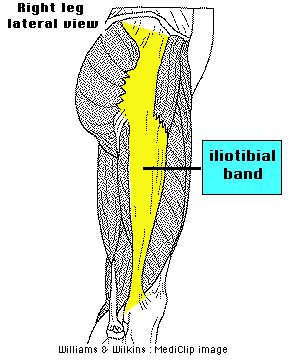
This time, in the category 'stretching' the IT band, or iliotibiale band. The IT band is situated on the outside of your upper leg and is prone to a injury around the knee. With some stretching you can deal with this injury of maybe even prevent it.

The IT band friction syndrome:

The IT band on the outside of your upper leg is attached to your hips, lets say underneath your belt while wearing jeans and runs all the way down to just below your knee where it is attached to your tibia, the shinbone in your lower leg.
Asymmetric loading that pushes the knee outwards will cause friction between the IT band an the outside of the knee joint. This is called the IT band friction syndrome. From my own experience I can tell you it can cause a somewhat nagging  pain while stretching the knee. During running this pain can become more serious and leading to a jolt of pain with every step you take.

So lesson 1: avoid asymmetric loading. So do not run on the same shoulder of the road all the time and when on a beach; turn back in time.

Stretching the IT band

Stretching this IT band can be done in multiple ways.

Method 1: It is a bit like skating on a 400m ice rink and full into the curve....

Method 2: A useful addition to method 1. To my opinion the first method tackles mainly the upper end of the IT band on your hips. This method as shown in the video is more prone to stretch near your knee!


Method 3: Is the same as stretching the gluteus maximus (or buttocks) to be found in this posting.

Tuesday, 14 August 2012

Stretching: Hamstring

Next on the menu for stretching exercises is the hamstring. You can stretch the hamstring at the back of your upper leg in various ways. There are two methods you can do sitting but it can be done standing as well. Standing is easier when outside during a run either warming up, or cooling down.

First one of the methods you can perform standing:


Sitting (one leg):


This exercise can also be done in a standing mode. Here is how:

  • Find a fence or wall of roughly the same height as your hips (a bit lower is OK, higher? Better not);
  • Place on foot on the fence, best your heel so you can point your toes towards you;
  • Bend the leg you stand upon until the leg on the fence is horizontal;
  • grab your foot as in the video.


Sitting (both legs): 


This one can be done in a standing mode as well and no, not by placing both legs on the fence.

Place your feet next to each other en simple bow and touch your toes or ankles as low as you can. If you come op do it slowly stretching your spine vertebrae by vertebrae.

It is also possible (and smart) to pay attention to your posture when you bend to touch your toes. Both in the sitting method as in the standing method. Not just reach for your toes and grab them as in the video.
  • Start with stretching your arm up try to reach for the ceiling/sky/heavens above depending your location and conviction;
  • make yourself as long as possible while keeping you feet flat on the ground;
  • Bend in your hips while your arms stay in line with your back all the way to the horizontal position of your upper body;
  • Then,  vertebrae by vertebrae, bend your spine and if agile enough your hands will touch your toes or ankles in due time;
  • Only if need be you can bend your arms at the shoulder to complete the movement and touch your toes.
By performing the stretch in this way your probably not only stretch your hamstrings but also your calf muscles. Wanna give them some special attention? Read my blog on stretching the calf muscles and the lower calf muscle.

Stretching: A streetplan to your Muscles

A couple of times I addressed the topic of 'Stretching' on this blog. I already addressed the calf muscle and the muscles in your but. More on this topic can be found by using the label stretching.

If you wanna know more on the various muscles in your body you can find the to images displayed below on the website of the BBC. Consider it a streetplan to the muscles in you body. If you follow the link to the BBC website you find these maps 'clackable and learn more on each an every group of muscles.

First the image with the muscles on the front of the body:
source BBC science


and secondly the back of the body:
source BBC science

While you at it. Enjoy also this interactive page with more information on the human body.

Friday, 3 August 2012

The future of exercising and healthy living?

A friend draw my attention to this very nice short movie. It is both a view into the future of exercising, healthy living (relevant for this blog;p) and dating but also has a nice story line with a great cliff hanger. Just sit back and enjoy (probably just on your tablet, smartphone or ordinary old fashioned laptop...

Thursday, 2 August 2012

RunningDutch Review: Amsterdam Marathon

This autumn will see the 37th edition of the Amsterdam Marathon.

The Location
Amsterdam is the capital of the Netherlands and abroad probably the most well known Dutch city. Probably for its canals, coffeshops  and red light district but also the 'Rijksmuseum' with paintings from Rembrandt and the Anne Frank House.
Important for you as reader of this blog: It is also the venue of a very popular marathon.

If you consider visiting Amsterdam to take part in the marathon you can consider to take a canal tour or a coffeeshop tour. The latter maybe after the race?

Hotels? No problem in Amsterdam as you can tell from booking.com or Expedia.

The course: Fast, scenic, historic and a brilliant finish 
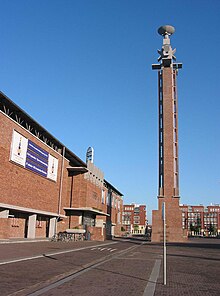
Tower in front of stadium
The course is flat and therefore fast. The wind however can be tricky but later more on that topic.
The start of the marathon is in the Olympic Stadium. Originally built for the Olympic Games of 1928 but beautifully renovated in 2000 with a very good 400m track.

After 200m on this track you leave the stadium passing the tower which held the Olympic fire and, with eye for detail, measures 42 meters and 19,5 centimers. Recognise the numbers?

Find your pace on the wide road leading away from the stadium towards the 'Vondelpark' on a average Sunday crowded with people enjoying the sun, jogging around etc. Remember the scenic part of the course as you will run it again in opposite direction on your way back. You run past the Rijksmuseum and loop back to the stadium.

 The cours:
> Flat
> Fast
> Historic
> Start & Finish in Olympic Stadium
Only 7k en route you leave the stadium behind you for a second time and head for the river Amstel to run on the historic route of the Olympic marathon of 1928. You join the rive around km 12 heading south east. Around km 15 you make a small loop leaving the river clearly added to make up the distance of the 42k.

You run on along the scenic Amstel joined by boats with music and people cheering you on. You cross the river at 19 and run back on the opposite site. At my pace (5min.km) I have the opportunity to see the elite running this homeward stretch while I myself still have the outbound leg ahead of me.

It is along this river that the wind can be tricky as the route is in the open.

As for most people the true marathon starts around the 25k. It is no fun to be running for some 5k in a more industrial area with little people along the route before you come into residential area's again.

I myself find the 37k mark the difficult spot. First you head into a short tunnel in order to cross underneath a major road. Climbing out of the tunnel you continue the climb to cross the Amstel once more. Only little elevation it is enough for me. If you experience no problems enjoy the view to your right while crossing the Amstel.

After running trough the Vondelpark the second and last time you head for the stadium to finish on the very comfortable running track. Feel like the elite runners cheered on from the stands by the people in the stadium.
clikc course map for lager image


The organisation: Professional
The event is very well organised, the infrastructure around the start en finish area is ok. The drop off point for  your bag with clothes can be crowded and the dressing area is in a sport hall a couple of 100 meters from the start and finish. Nice for warming up and cooling down. On a colder October day this can mean you can get a little bit cold before you can change you wet running apparel. You'll get a thermo blanket after the finish line to stay warm.
The route (see above for more details) is free of cars and spectators, refreshing posts are with water and sports drinks at every 5k. No complaints on this front.

The entourage: OK
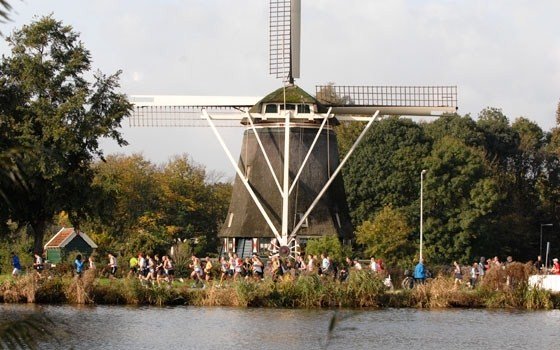
Coming from abroad the route can be found scenic both in and outside the city. Don't expect to run in the old city centre but do enjoy the windmill around the 15k mark.
Except for the spectators in the stadium most people along the route are either cheering on a friend or semi interested locals not really making it an effort to be to enthusiastic.

For the spectators
As you might know cycling is very popular in the Netherlands so consider renting a bike and you can cheer on you friend, husband, wife, father, mother, etc a couple of times along the route. Using the metro you can do the same. Start for example in the stadium, than wait outside for the runners to come by after the 7K loop. take the metro to f.e. the 30K mark which is very close to a metro stop. This will give you plenty of time to go back to the stadium to see the finish of your .......(fill in the appropriate reference to your runner).

The verdict
OK, Amsterdam is not one of the biggest marathons but is very popular for tourist so why not consider to combine your running exploits with a visit to Amsterdam? And maybe take home a Personal Best on the flat course.

Wanna read more on Amsterdam? Hit the Amsterdam label and see my other 3 postings on Amsterdam.

Below a Youtube slideshow which offers an impression of the 2011 edition: